

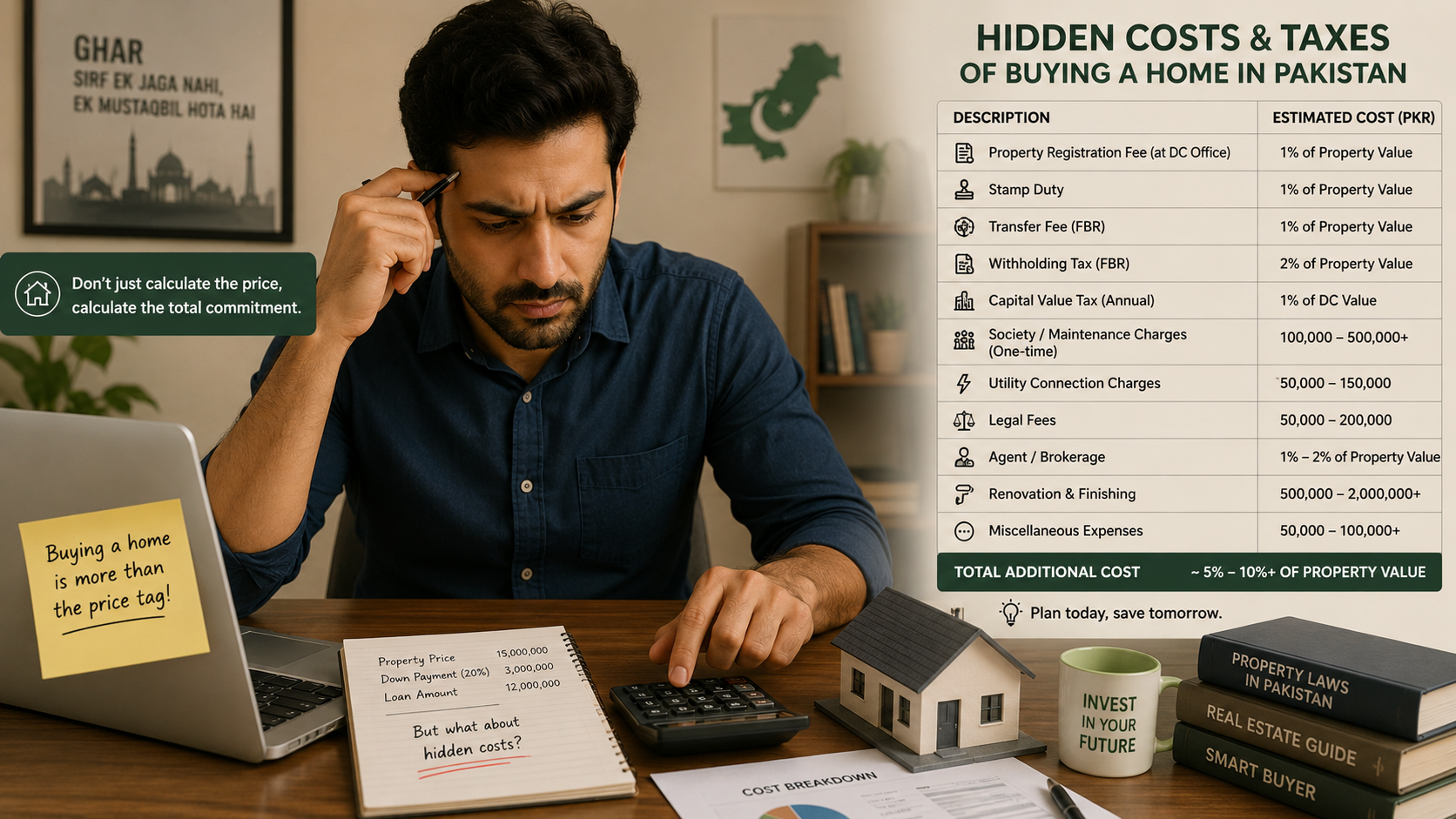
Most people budget for the price on the listing and nothing else. Then transfer day arrives, and the taxes, society charges, agent commission, and paperwork fees push the real cost thousands, sometimes lakhs, above what they planned for.
The honest number to keep in your head is this: on top of the purchase price, budget roughly 5 percent to 10 percent extra if you are a tax filer, and more if you are not. On a one crore home that is an additional five to ten lakh rupees, and almost none of it is optional.
This guide breaks down every hidden cost of buying a home in Pakistan in 2026, who you pay it to, and whether you can claim it back later. At the end there is a full worked example for a real DHA Lahore purchase so you can see exactly where the money goes.
Quick answer: what extra costs should you budget for?
Here is the full picture at a glance. The rest of the guide explains each line.
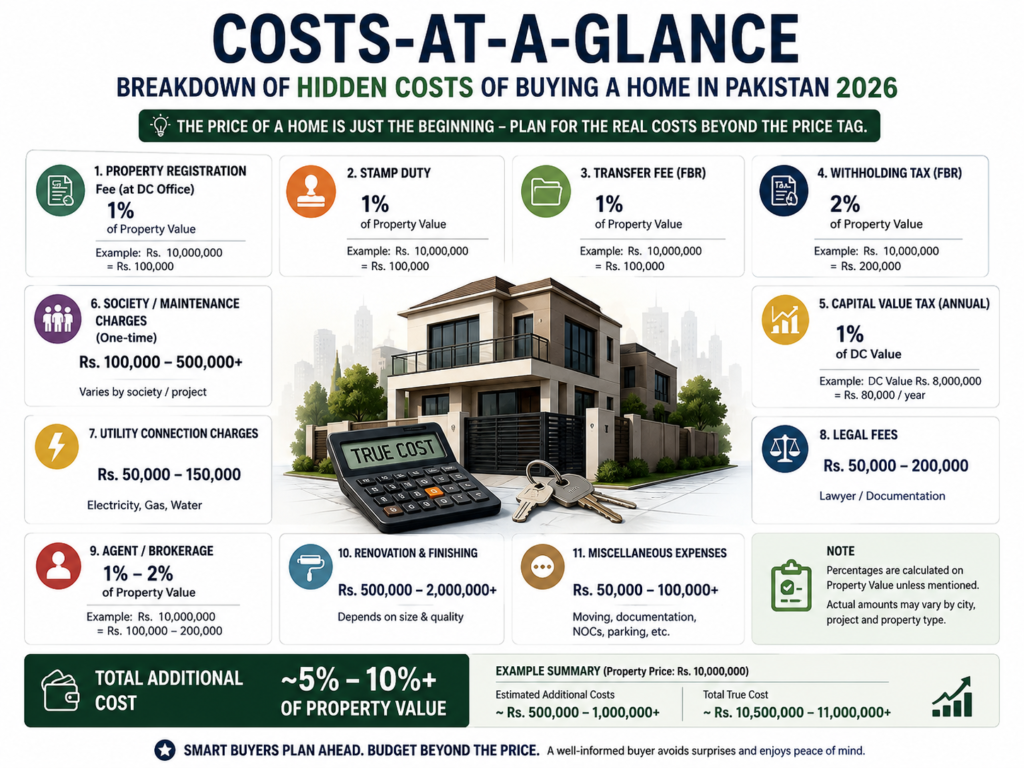
| Cost | Typical amount | Paid to | Can you recover it? |
| Advance tax, buyer (Section 236K) | ~1.25% (filer), ~2.5% (non-filer) of value | FBR | Yes, adjustable in your tax return |
| Stamp duty | ~1% in Punjab (varies by province) | Provincial govt | No |
| Capital Value Tax (CVT) | 2% where it applies | Federal/provincial | No |
| Registration / mutation fee | ~1% of value | Sub-registrar / society | No |
| Society or authority transfer fee | PKR 30,000 to 200,000+ | DHA, Bahria, LDA, etc. | No |
| Agent / dealer commission | ~1% from the buyer | Property dealer | No |
| Legal and documentation | PKR 30,000 to 75,000 | Lawyer / consultant | No |
| Utility connections, deposits, dues | PKR 30,000 to 100,000+ | WAPDA, SNGPL, WASA | Partly (deposits) |
| 7E certificate (if you own property over PKR 25M) | ~1% of value, annual | FBR | No |
| Renovation, repairs, moving | Highly variable | Contractors, movers | No |
Note that federal taxes are calculated on the FBR or DC valuation, not always the price you actually pay. In premium societies the official value is now close to the market rate, so do not assume the tax will be small.
The government taxes and transfer charges
These are the largest hidden costs, and the ones buyers underestimate most. Rates changed on 1 July 2026 with the FY2026-27 budget, so ignore any figure you read on an older article.
1. Advance tax for buyers (Section 236K)
When you buy a plot, house, apartment, or file, FBR collects an advance income tax from you at the moment of transfer. As of the FY2026-27 budget, the buyer rate is roughly 1.25 percent for active filers and about double that for non-filers. It is calculated on the FBR or DC value of the property.
The good news is that 236K is adjustable. When you file your annual income tax return, this amount is offset against your total tax liability, and if you overpaid you can claim it back. The catch is that you must pay it upfront in cash to complete the transfer, and if you are a non-filer there is no easy way to recover it.
This single tax is the strongest financial reason to be on the Active Taxpayer List before you buy. More on that below.
2. Stamp duty
Stamp duty is a provincial tax on registering the transfer deed. It is not uniform across the country. In Punjab, including Lahore, buyers should budget around 1 percent of the DC value, though Punjab also applies fixed amounts on certain deed documents and small town or corporation fees on top. Other provinces differ: Sindh is around 2 percent, Islamabad Capital Territory around 2 percent, KPK around 3 percent, and Balochistan around 4 percent.
Stamp duty is non-adjustable. You pay it and it is gone. Verify the exact current schedule on the Punjab e-Stamping portal or with your sub-registrar before you calculate your budget.
3. Capital Value Tax (CVT)
CVT is charged at 2 percent of the property value where it applies. Its applicability has shifted between provinces and the federal government in recent years, and some jurisdictions have moved to phase it out to revive the market. In many DHA and society transfers it still appears as a line item. Treat 2 percent as your planning figure and confirm whether it applies to your specific transaction and location.
4. Registration and mutation fee
To put the property legally in your name, you pay a registration fee, usually around 1 percent of the value. For properties in a registry area this goes to the sub-registrar; for society properties the transfer is recorded by the society. This is where the intiqal (mutation) and fard documents are processed. It seems minor, but on a high-value property in DHA, Gulberg, or Bahria Town, 1 percent is a real number.
5. The seller’s taxes you might end up paying
Legally, the seller pays advance tax under Section 236C (roughly 2.75 percent for filers and 5.5 percent for non-filers as of FY2026-27) plus Capital Gains Tax on any profit. So why does this matter to you as a buyer?
Because in the Pakistani market the tax burden shifts through negotiation. If a seller faces a heavy 236C or CGT bill, they often quote a higher “net to me” demand and let you absorb the difference. You may never see it itemized, but it is baked into the price. Knowing the seller’s likely tax position gives you leverage in the negotiation.
On CGT specifically, the rules changed in July 2024. For property bought on or after 1 July 2024, filers pay a flat 15 percent on profit regardless of how long they hold it. Property bought before that date still enjoys the old sliding scale that drops to zero after several years. Non-filers pay considerably more.
6. The 7E certificate (the one nobody warns you about)
Under Section 7E, anyone owning immovable property worth more than PKR 25 million in total is treated as earning a “deemed income” on it and taxed roughly 1 percent of the value annually. The reason it becomes a hidden cost of buying is simple: you cannot complete a property transfer without a 7E certificate (Form A) from the Commissioner Inland Revenue if the threshold applies. Buyers discover this at the worst possible moment, on transfer day, when the deal stalls because the paperwork is not ready. Sort it out early.
One more to note if you are buying directly from a developer: a Federal Excise Duty of around 5 percent can apply to the first allotment or transfer of residential and commercial plots in the primary market.
Society and development authority charges
If you buy inside DHA, Bahria Town, LDA City, or any private scheme, the society charges its own fees on top of everything the government takes. These are entirely separate from taxes.
Transfer fee. The society charges this to move the file into your name. In DHA Lahore it commonly ranges from around PKR 30,000 to 200,000 or more, depending on plot size and property type. Ask for the exact figure for your specific plot before you agree to anything.
Membership and development charges. Some societies require a membership or associate fee before a transfer can proceed. In under-construction schemes, buyers are often liable for development charges covering roads, sewerage, electricity, parks, and utility infrastructure. These can run from PKR 50,000 to several lakh depending on the society and phase.
Possession and utility connection charges. Taking physical possession, and getting water, gas, and electricity infrastructure connected, often carries its own charges that are not part of the plot price.
Location premiums. This is the quiet one. Corner plots, main-road plots, and park-facing or boulevard-facing plots frequently carry a premium set by the society or the seller. Buyers who fixate on the base rate get surprised when the “nice” plot costs meaningfully more.
Always request a complete written fee breakdown from the society or developer office before you pay any token.
Professional and service costs
Agent or dealer commission. In most Pakistani cities it is customary for the dealer to charge around 1 percent from the buyer and 1 percent from the seller. On a one crore purchase that is roughly PKR 100,000 from your side alone, and buyers routinely forget to budget for it.
Legal and documentation. Drafting the sale agreement, verifying the title, checking for encumbrances or disputes, arranging the NOC, and preparing the transfer paperwork all carry fees. Depending on the complexity of the deal and the professional you hire, expect anywhere from PKR 30,000 to 75,000, sometimes more.
Title verification and due diligence. Paying a lawyer or a reputable firm to confirm the fard, ownership history, and that the society is approved by the relevant authority (LDA, RDA, or CDA) is not a cost to skip. It is far cheaper than buying into a disputed or unapproved property.
After you get the keys
The costs do not stop at transfer. First-time buyers are often caught off guard by what comes next.
Utilities and cleared dues. You will pay to connect or transfer electricity, gas, and water, including new meter charges and security deposits. Critically, you may inherit the previous owner’s unpaid bills unless you insist on clearance certificates before the deal closes. Check the payment history with each department.
Renovation and repairs. The older the house, the higher the chance of hidden repair costs, from roof sealing and plumbing to rewiring and fixtures. A professional inspection before you finalize is well worth the fee, because it lets you either negotiate the price down or walk away.
Moving and shifting. Loader trucks, labor, and packing add up, especially if you are relocating from another city.
Annual property tax and society maintenance. Once you own, the provincial excise and taxation department charges an annual Urban Immovable Property Tax (in Punjab, calculated on the annual rental value), and societies charge ongoing maintenance for security, garbage collection, and upkeep. These are recurring, not one-time.
If you are financing the purchase. A bank home loan adds a processing fee, and often mandatory property or life insurance, on top of the markup. Factor these in before you commit.
A real worked example: PKR 2 crore house in DHA Lahore
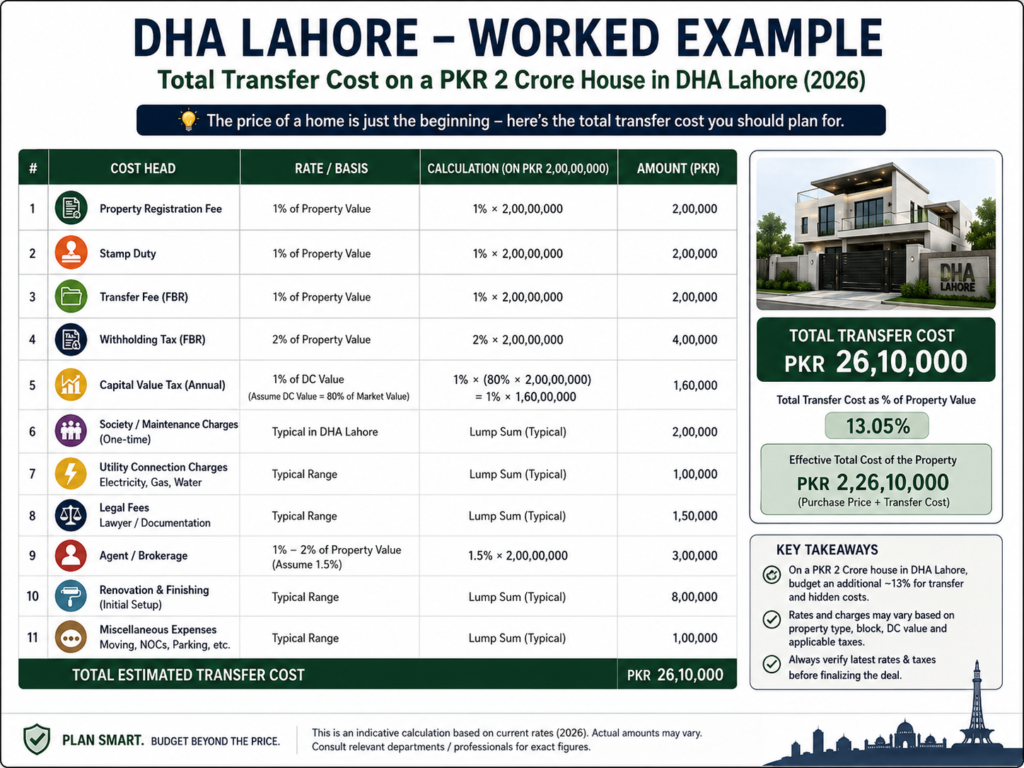
Numbers make this concrete. Say you are an active filer buying a house valued at PKR 2 crore (20,000,000) in DHA Lahore. Here is a realistic estimate of the extra costs on top of the price. Assume the FBR or DC value is close to the purchase price for simplicity.
| Cost | Estimate (filer) |
| Advance tax, 236K (~1.25%) | PKR 250,000 |
| Stamp duty (~1%) | PKR 200,000 |
| Registration / mutation (~1%) | PKR 200,000 |
| CVT (2%, if applicable) | PKR 0 to 400,000 |
| DHA transfer fee | PKR 100,000 (varies by size) |
| Agent commission (1% buyer side) | PKR 200,000 |
| Legal and documentation | PKR 50,000 |
| Utility transfers, deposits, clearances | PKR 60,000 |
| Approximate total on top of price | PKR 1,060,000 to 1,460,000 |
So on a 2 crore home, a filer should budget roughly PKR 10.5 to 14.5 lakh in additional costs, or about 5 to 7 percent, before spending a single rupee on renovation or moving.
Now the filer versus non-filer gap. If you were a non-filer, your 236K alone would roughly double, from PKR 250,000 to around PKR 500,000, an extra PKR 250,000 you cannot easily claim back. That difference, on this one transaction, is the clearest argument for getting on the Active Taxpayer List before you buy.
One useful detail: this 2 crore example sits just below the PKR 25 million 7E threshold, so a 7E certificate would not apply here. Buy anything above 25 million and you must add the 7E certificate step and its annual deemed tax.
These are illustrative estimates. Your actual figures depend on the FBR valuation, your filer status, the specific society, and the current-year rates, so verify each one before you transact.
Five ways to avoid nasty surprises
- Become a filer before you buy. Get on the ATL well ahead of the transaction. It roughly halves your withholding tax and makes it recoverable. Registration takes a few weeks, so do not leave it to transfer day. Check your status at iris.fbr.gov.pk.
- Demand a full written cost breakdown before paying token. Ask the dealer, seller, and society office to list every tax, fee, and charge in writing. Verbal estimates are where surprises hide.
- Check the FBR and DC value, not just the market price. Federal taxes are calculated on the official value. In premium societies that value is now close to the market rate, so confirm it early.
- Verify approval and clear all dues first. Confirm the society is approved by LDA, RDA, or CDA, get the fard and 7E paperwork moving, and insist on utility and society clearance certificates so you do not inherit someone else’s bills.
- Keep every receipt. Digital and physical copies of every challan, pay order, and transfer receipt protect you legally and are essential for claiming back your adjustable taxes.
Final thoughts
Buying a home in Pakistan is one of the biggest financial decisions you will make, and the listing price is only the beginning of it. The buyers who plan well are the ones who add up the taxes, society charges, commission, and paperwork before they commit, not after. Do that, and there are no unpleasant surprises on transfer day.
At Royal Properties, we walk our clients through the full cost picture before they sign, including a tailored transfer-cost estimate for the exact property and society you are considering. If you are planning a purchase and want the real all-in number, get in touch with our team and we will map it out for you.
Disclaimer: This guide is for general information only. Property tax rates change with every Finance Act, and the FY2026-27 rates took effect on 1 July 2026. Royal Properties is a real estate company, not a tax or legal advisor. Always confirm the current rates and your specific liability with FBR, your sub-registrar, and a qualified tax professional before completing any transaction.
Frequently asked questions
As a rough rule, budget an extra 5 to 10 percent on top of the purchase price. For a filer buying a 2 crore home, that is roughly 10 to 15 lakh rupees in taxes, transfer fees, commission, and paperwork, before renovation and moving. Non-filers pay more.
Buyers pay advance tax under Section 236K (around 1.25 percent for filers as of the FY2026-27 budget), plus stamp duty, CVT where applicable, and a registration fee. If you own property worth over 25 million rupees you also need a 7E certificate to transfer.
Much cheaper as a filer. Non-filers pay roughly double the advance tax on the same property, and unlike filers they cannot easily claim it back. Getting on the Active Taxpayer List before you buy is one of the simplest ways to save money on a purchase.
It varies by plot size and property type. In DHA Lahore it commonly ranges from around 30,000 to 200,000 rupees or more. Always ask the society office for the exact figure for your specific property before agreeing to a deal.
Both. Buyers pay advance tax under Section 236K at transfer. Sellers pay advance tax under Section 236C plus Capital Gains Tax on profit. In practice, sellers often build their tax into their asking price, so buyers can end up carrying part of it too.
Section 7E treats owners of property worth more than 25 million rupees as earning a deemed income, taxed at roughly 1 percent of value annually. If the threshold applies, you cannot complete a property transfer without a 7E certificate from FBR, so arrange it early to avoid delays.